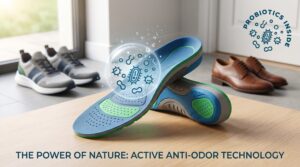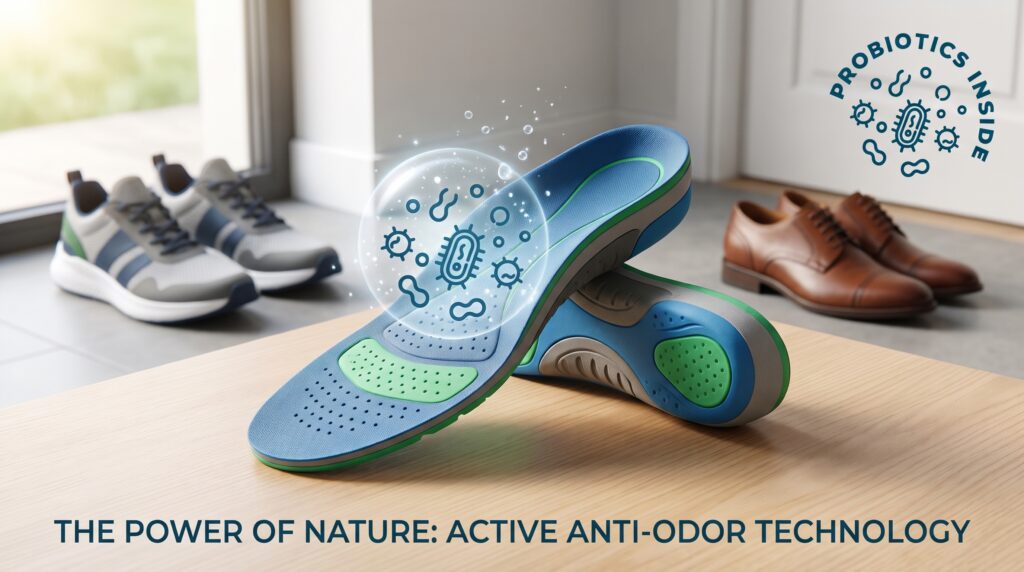
Shoe odour is an everyday problem, but its biology is surprisingly complex.
Rather than resulting simply from perspiration, footwear malodour is associated with volatile organic compounds (VOCs) generated by microorganisms living on human skin and within footwear. Research cited in our study also indicates that certain beneficial bacteria can degrade odorous compounds into odourless metabolites.
This raises an intriguing question:
Could beneficial microorganisms be incorporated directly into shoe insoles to create a new generation of functional footwear?
At Probiotic Group, our R&D team investigated one of the fundamental technical questions behind this concept: can probiotic spores effectively attach to shoe-insole materials and persist over time?
The results provide encouraging first answers.
Testing probiotics on shoe-insole materials
Three different insole materials were evaluated.
Small 2.5 × 2.5 cm sections were immersed in a probiotic spore suspension containing 10⁷ CFU/mL. Two processing conditions were compared:
- 45-minute incubation
- overnight incubation
Following treatment, the materials were rinsed to remove loosely attached spores, dried and analysed.
The researchers then measured the microorganisms immediately and again after two and four weeks to determine their persistence.
Probiotic spores successfully attach to insole materials
The first important finding was clear: probiotic spores could be recovered from all three tested materials after application.
After 45 minutes of incubation, the average level was:
- 4.85 ± 0.08 log10 CFU/cm²
After overnight incubation, this increased to:
- 5.40 ± 0.11 log10 CFU/cm²
Interestingly, the type of insole material did not produce statistically significant differences in probiotic attachment under either condition.
Processing time, however, did.
Overnight treatment produced higher spore counts, with statistically significant differences for two of the three materials.
A potentially important finding for product development
This suggests that, among the three substrates tested, optimising the probiotic application process may be more important than selecting a particular material solely for microbial attachment.
That could give footwear manufacturers greater flexibility when developing probiotic-functionalised materials.
Probiotic spores persisted for at least four weeks
Initial attachment is only part of the challenge.
A functional material also needs to retain the microorganisms over time.
The study therefore followed recoverable probiotic spores over a four-week period.
Following 45-minute incubation, some reduction occurred during the first two weeks, particularly for Materials 2 and 3. Counts subsequently remained relatively stable between Weeks 2 and 4.
With overnight incubation, counts were generally more consistent throughout the four-week study.
Importantly, probiotic spores remained detectable at relatively consistent levels across all three materials after four weeks under the experimental conditions.
Why probiotic footwear could be interesting
Traditional approaches to shoe odour frequently focus on controlling or masking unwanted smells.
A probiotic approach introduces another possibility: using selected beneficial microorganisms as an active biological component of the material.
The scientific rationale investigated here is that probiotic bacteria could potentially interact with compounds associated with footwear malodour.
However, there is an important distinction:
The present study demonstrates attachment and persistence. It does not yet demonstrate odour reduction in worn shoes.
That distinction is essential scientifically and commercially.
Moving from the laboratory to a real shoe
The next phase therefore goes beyond simply demonstrating that probiotic spores remain attached.
Five development areas have been identified.
1. Develop an industrial application method
Instead of laboratory immersion, manufacturing could investigate:
- spraying,
- coating,
- impregnation.
The objective is to achieve uniform probiotic distribution while limiting losses and maintaining an economically scalable process.
2. Optimise processing time
Longer incubation improved initial attachment, but an industrial process must balance microbiological performance against production speed and cost.
Spore concentration, application volume and drying conditions should therefore also be optimised.
3. Test real-world durability
A shoe is considerably more demanding than laboratory storage.
Future testing should therefore reproduce:
- mechanical compression,
- friction,
- moisture,
- temperature fluctuations,
- humidity,
- storage conditions.
4. Demonstrate microbial activity inside footwear
Detecting probiotic spores is not equivalent to proving metabolic activity.
Research should establish whether microorganisms can germinate and become active under realistic shoe conditions, including exposure to humidity, temperature and sweat components.
5. Demonstrate actual odour reduction
Ultimately, consumer benefit must be measurable.
Controlled tests comparing untreated and probiotic-treated insoles could combine sensory-panel evaluation with analytical measurement of relevant volatile malodour compounds.
From passive material to microbiologically functional material
This research represents an early but important step.
The study shows that probiotic spores can be successfully incorporated into several tested shoe-insole materials and remain detectable at relatively consistent levels over at least four weeks under the investigated conditions.
The next challenge is demonstrating that this microbiological presence translates into real and reproducible odour-control performance during everyday use.
If that can be achieved, the opportunity extends beyond a simple “fresh shoe” product.
It points toward a broader category of microbiologically functional materials, where beneficial microorganisms are incorporated into everyday products to provide functionality over time.
For footwear manufacturers, material specialists and brands looking for new approaches to hygiene and odour management, probiotic-functionalised shoe insoles could represent an exciting field of innovation.
Interested in exploring probiotic-functionalised materials?
At Probiotic Group, we develop microbial and probiotic technologies for integration into products and materials.
If you are developing footwear, insoles, textiles or other materials where malodour is a challenge, contact us to explore whether microbial technology could become part of your next product innovation.